
From Alcoa’s founding to park traffic and the downtown hole
Choose your platform:





TRANSCRIPT
Hey everybody, welcome to Let’s Be Blount, a podcast about living and loving everything Blount County, Tennessee. We’re your hosts, Brett Heppner and Eric Rice, the property dads at LeConte Realty, and we’re excited to talk more about this great place we call home. Today’s guest, as you can see sitting in front in the middle of us here, is Greg McLean, city manager for the city of Maryville, or as the profile on somewhere I read described you as the longtime city of. Yeah. So, Greg, welcome to Let’s Be Blunt. Thanks for having me today. I appreciate the invite. Thanks for joining. Yeah. So since we are Let’s Be Blunt, we talk a lot about, I mean, it’s solely Blount County. It’s all we’ve ever done, 70-some guests of something to do with Blount County. And you are pretty much as Blount County-an as you can get. So tell us a little bit about your growing up background, Blount County history.
Well, first thing is, yes, I’ve been Blount County, I say all my life. However, I was actually born in Salina, Kansas.
No, you were not born in Salina, Kansas. I was.
Eric was born in where?
Well, I was born in Pratt, but I grew up in Salina, Kansas. Okay. Well, dad was a soldier, so we were shillings way back in the 60s, 50s and 60s. And when I came along, we just happened to be stationed there. And then as quickly as we could get back home, when Dad went off to Alaska, we said, we love you, but we’re not following you to Alaska. And we came home and settled back into Blount County. So went to the, you know, Eagleton Elementary and the junior high in Everett. Yeah, been here a long time. Long time. So straight out of college, career-wise successful. Actually, while I was in college, I was working for an architect. I’d start out wanting to be trained as an architect until I worked for one and decided that’s not what I wanted to do. But they were working with the aluminum company, which was back home where I was from, and that… Ultimately led me into working for the aluminum company and did that for about a 15 year stint. And then city of Alcoa and then the city of Merrill. My grandmother said, I can’t keep a job. She’s quite disappointed in me. Because you came to the city of Alcoa in 2002. Is that right?
Came to the city of Alcoa in 1993.
Oh, OK. But but you were then your job changed in 2002.
Right. That’s when I came to the city of Maryville. City of Maryville. Okay. Right. That’s what I meant. Yeah. So, and became, you just explained to me, for four years you were… Deputy city manager. Under Gary Hensley. And, you know, the plan there was they decided to… See if I would work out. So they, in essence, recruit, recruited me. Sure. And gave me four years with Gary to prove whether I’d be worthy of following him or not. The way they put it is we won’t make you a promise if you don’t make us a promise. And I didn’t, that I even take it if they offered it. But after four, actually four and a half years, I enjoyed the work. They, I think, felt that I was competent enough to, to follow him. So, yeah. The rest is history. And Gary started as city manager in like 79, I think. Yeah, he was 28 years, I think, city manager. Yeah, two city managers in the city of Maryville in the last… I’m going to have to do math in my head.
Yeah. 50 years almost. Since 1967, there’s only been five. Wow. Yeah. That’s quite a run. I know. So many folks, maybe not when you were growing up, but I know many folks sort of go leave Blount County and come back to raise. You never left. Once you got established here, you never left.
What was it about it that made you stay and made you want to?
I think it was family, mostly family. I grew up in a very large family. My dad was one of seven. Mom was one of nine and very blue collar. So all of the men and many of the women in that group of folks, which you add that all up, it’s 30 plus. They were all very blue collar. And much of what I knew was, was blue collar work. So going to school and taking architecture was not something many of my family had ever done. And even though I was moving towards a white collar type progression, I still never got past blue collar, the love for blue collar work. So I was a block mason, I laid brick and block as a young kid. I still like to do that on occasion, actually. I’ve got a couple of projects. I was thinking I did, too. We might have to talk after the podcast, but no. But just wanted to stay close to family, I think, is what really drove me to stay in town.
We wanted to focus this episode on more of the history of Blount County. Obviously you have a long tenure with the city of Maryville in this area in what you have done in your career, but we have been told by multiple people that you’re quite the historian, that you have a really good grasp on the history of Blount County and sort of what has made it what it is. And so, you know, going forward, we may talk a little bit more about city manager, but we want to focus on the history. And the one thing I wanted to ask is if if you were introducing someone to the history of Blount County today, as as we are, hopefully, where would you start? What would what are the stories that people living here now need to know?
Well, I had written a couple of notes down here, and I think something that’s very significant that a lot of people probably wouldn’t know is that we’re 231 years old. So that makes us one of the oldest cities in the state. We’re actually older than Tennessee as a state. So when we were formed, it was still part of the territory south of the Ohio River. And just by virtue of that, just the deep, rich history that we have here can’t be told in one setting or two settings or take a lifetime to tell it. But I think to me, and you’ll probably hear me say that many times, it’s all about the people. When you look back through the history of the folks that were here, the type leaders we had, the folks that have given of themselves, not just to make money, but gave themselves to the community itself is what really is what the history is all about. You know, I think we get hung up sometimes on this old building or that old building or some business building. But behind all of that was somebody, some person that invested themselves. And we see it just continuing today. So we’re just part of this long continuum of history. And all of us need to leave our mark as well.
Sure. Do you have an example of that person or a couple of people that… You sort of point to?
– There are hundreds that we could talk about, but one that’s real special to me, I wrote an article about him. His name is A.K. Harper, Andrew Knott Harper. He was a mayor at one time for the city. He was also a businessman. He owned a business on the corner there at Cusick and Broadway, which is where Bill Cox Furniture is today. At one time it was struck by lightning and burned down. They bought a lot behind him, built another building. What’s really intriguing about A.K. Harper to me is the fact that he invested himself in government, he invested himself in business, he invested himself in his church, he invested himself in all things community. He was very much the giver and helper of other people starting other businesses. He and his wife Pandora raised their children, but there’s as much as there’s wonderful parts about the story, there’s lots of tragedy too that again make it very rich that even amidst all the tragedy that they did a lot.
AK’s first wife died just after she gave birth to her son Edward. He married Pandora, who became the stepmother. They had two more children. Their son Milton died in France on the battlefield. Eleven days later, their son Fred died of diabetes. So if you go to the AK Harper Library, Dandelions today, and you walk inside and look up, you’ll see the plaque that Pandora had left in there for her husband and two sons. Hmm. And that’s just one story of just literally hundreds and hundreds of stories of people that made their life here and died here. Eric does an excellent job of laying out questions so we can prepare our guests. I am more of a, hey, that reminds me of something, so I’m going to throw something else out. Is there, obviously, when I think back to 231 years ago, it was a pretty rural community. Were there significant developments?
The Alcoa plant, I mean, obviously was big for the city of Alcoa.
Were there significant things along the way that really boosted the city of Maryville?
Yeah. So up until about 1900, this is a sleepy town. Sleepy place. Everything that ever happened that was entertainment or you did your banking or anything governmental was all downtown. That’s all around Maryville up till about 1900. So the first hundred years were very sleepy and then things really began to change as the industrial age came along. Some of the significant things that really made a huge difference in our town were was when the park was formed. And they made a national park. As you know today, most visited park in the whole country by far. So that was in 1926. 1933, TVA came in and harnessed power harness the rivers, not so much to generate power and electrify the valley, which it did, but it was much more developed to stop flooding. It was just destroying farmlands and low-lying areas, and the damage of that was horrendous. So getting that under control allowed a lot more development and the spreading out of development. They helped the farmers understand how to farm better, taught them about fertilizers and all this kind of thing and how to rotate crops. I made a huge difference. The airport came here in 1939. What a wonderful asset that is, right? Then the Air Base in 1950 shows up and brings that economy into us. So, yeah, there’s tremendous amounts of significant things that have happened.
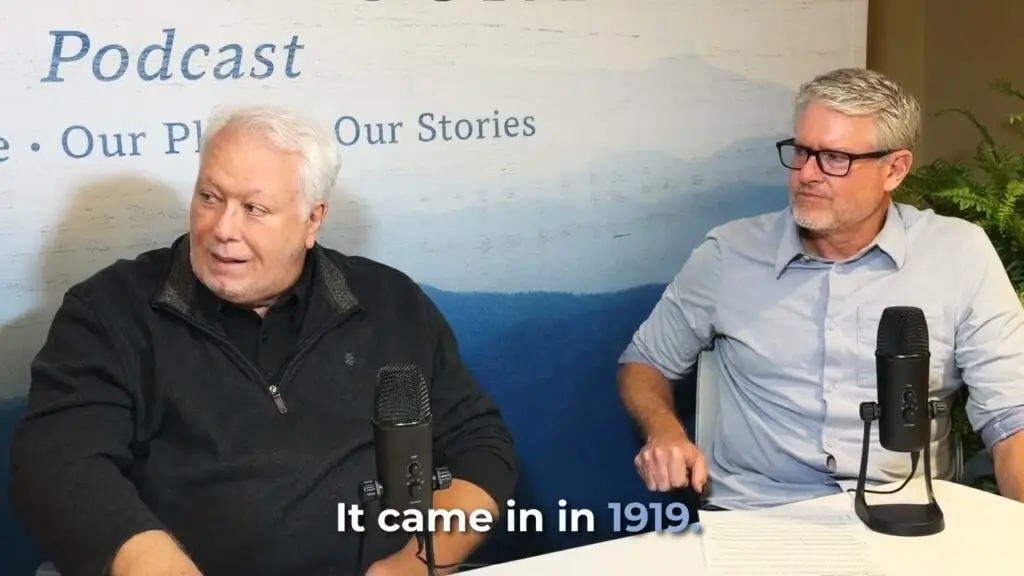
Yeah, especially that’s a fairly short period of time for all that, like 50 years to all that stuff to happen. Not to mention the Aluminum Company of America coming in here and changing everybody’s world. One thing you may not know, and I think I’ve got it written down here, is… The population of our town of Maryville was 2,115 in 1900, right? Just 20 years later, our population went from 2,100 to 3,358, right? And Alcoa didn’t exist in 1900. It came in in 1919. When it was formed, it had a population. I’m sorry, we were 3,700 from 2,100 to 3,700. But Alcoa was 3,358. Almost immediately. Immediately. Within a very short period of time, our population well over doubled in this community. So back in the 30s, people were like, gosh, it has taken me forever to get from one side of town to the other, which is my whole memory today.
You say that, Jess, but I spent a fair amount of time reading the old newspapers from back in the 1920s and the 15 and even in the 1800s. And it’s like you’re reading it today. People did not want the aluminum company to come in here. They were going to tar and feather Sam Everett, who was mayor at the time, literally going to tar and feather him because they just didn’t want this little town to change. They didn’t want the impacts. So how did the aluminum company, because we go to Townsend, we’ve been to Alcoa, we’ve been to all different parts of Blount County. Not all different parts. We’re still working on it. So we like to try to spread the love a little bit. But how did that happen?
Seems to be a really significant piece of history. How did that company change people in Alcoa specifically?
Well, it’s very interesting that when the plant that was sought after, Sam Everett, Raw, Hannah, and some others, John Clark’s great-grandfather was one of them. They went and pursued this new company called the aluminum reduction company out of Pittsburgh. And they knew they were looking for someplace that had the ability to harness power. They needed lots of energy to smelt aluminum. So they sought after them, they came here. A lot of people didn’t want them here. But the idea was you bring in this great company, they’ll pay a lot of taxes, At the time they brought them in here, the roads were still dirt. There was not a whole lot of sewer in and around the town. So, you know, to be a progressive community, you want to, you know, bring in a big company and bring in the taxes. So in doing that, Alcoa had other ideas. They, being a big company and a sophisticated company, decided to form their own city and not be a part of Maryville. So J. Walter McMahon, who’s the doctor for the plant, was also a state House of Representatives that then was elected senator. He took the incorporation bill to Nashville and got it passed to incorporate the city of Alcoa. And all of Maryville thought it was up at Calderwood. So it was a little shaky when he came back. He was the representative of Maryville, and he pulled this fast one the way it felt. And the city of Alcoa was formed. So when it was formed, there was no intention to give any taxes to Maryville. But Maryville was teaching all their children. So they said, well, if you’re going to be a bona fide city, you need to teach your own children. So we’re sending your children back to you. And they had to convert an old mule barn really quick as a school until they could get one built. So lots of impacts, not just financially, but socially and relationally. The sleepy little town went to a, you know, became a very sophisticated, complex community overnight.
Yeah. And so not to jump ahead a lot, but you mentioned that, you know, when you read the paper back in the 20s, it sounds very similar to the issues because they’re like, we don’t want big companies. We don’t need any more people, the number of people that we have. I mean, these are things that you hear today.
Yes. So I would assume as city manager, that is a give and take. So how do you deal with that?
Yeah. Well, it’s very interesting. I think what’s bringing people here today has changed. You know, it used to be that when you’re looking for some place to go or, you know, if you look at how we’ve grown over the years, it’s been somewhat different. Up and down and up and down, but the trend line is less than a percent a year. If you go all the way back to 1795, we’re, from a percentage standpoint, we’re not growing crazy. We’ve had our moments where it’s been high, but we’ve also had our moments like in ’08 when we had no growth. So people used to come here for lots of different reasons. In the last number of years, with the politics being what they are, a lot of people, we call them refugees. They’ve tried to get out of the big cities that have somewhat lost their mind. Taxes are very high. Cities are being burned down. It’s just caused people to say, I need to go somewhere else. And then they look on the internet and say, any place sane, and Marable pops up. If you look at what we have to offer as a community in light of the fact that our cost of living is lower than the national average, our wages are better than the national average, our crime rate is lower, education is superior. We have four seasons. We have the mountains, we have the lakes, we have the proximity to a big city, but we’re not a big city. It’s just a perfect place to come. And so as a city manager, you do your very best to try to manage what you’re dealt, the hand you’re dealt. I think it’s a misnomer to say control growth. I’ll get drummed out of some people’s social media page by that. But the truth of the matter is, if you want to control growth, tell me how to do that. Is there a gate you put up somewhere? There’s really not. I would tell you how you stop growth. The way you stop growth is don’t fix potholes, don’t fund your schools.
– Make it a less desirable place to live.
– Less desirable.
– Become the kind of place that people don’t want.
– Yeah. It’s either that or take away property rights because if someone has a piece of property they want to sell or a piece of property someone wants to buy, how do you say you can’t do it? The closest we can come to is zoning.
To put zones on there. So as city staff, as city council, everybody’s trying to get their arms around how to deal with this. And the really sad thing is that I watch is the vilification, the vilification of elected officials, the vilification of anybody in development whatsoever. And that’s really, really unfair because what makes cities great, what’s made Marable great over the years, are people who want to come and invest their own money, risk themselves, risk their wealth to not only do for themselves but to do for the community.
A.K. Harper, same kind of guy. I mean, he invested his whole life savings into his business to watch it burn down. And what’s he do? He crawl in a hole and blame somebody? No, he just went and got a loan and built another building. And it was to serve the community as well and make a living. So as a city manager, it’s a difficult day-to-day process to try to manage what you’re handed. A lot of people, I love it when they say, well, we want red lobster, just go get it. Or we want this, just go get it. Or we don’t want that, stop it. That’s not how it works. Yeah. You’ve had a sort of a front row seat to all of this growth. And you as a historian have, I think, looked at way more of where we have come from than most people. Is there anything that surprises you maybe in our history here in Blount County? And, you know, going back as far as you want to go and even into, you know, modern day, but… Anything that surprises you change-wise that has made a difference here?
I don’t know, surprise is maybe the term. Maybe it’s, I’m somewhat disappointed in the changes that are coming. Again, if you read the paper back in the 20s and 1800s, there were the same type of reactions that people have. And even back then, that seemed to be what the press would write about. I think the vast majority of us see it for what it is and embrace it. Life’s too short to go through it negative in this life’s too short just to Want to complain all the time about our lot of life But to make make good on it, so I guess I’m disappointed in the fact that there is the vilification of people Just doing their jobs just doing what has created a wealth for the community and wealth for people who’ve made a lot of jobs for folks and So I don’t know that I’m surprised by it, but disappointed a little bit that then the struggle goes on. And I want to believe that at some point that will turn and people will get back to appreciating one another and appreciating what we have here. I don’t buy it that this is a bad place or it’s not what it used to be. It’s a better self of what it used to be. It just continues to grow, and it’ll be what we make it. And I’m just the eternal optimist in that regard. It’s funny that that’s the word I was going to use about myself, because a lot of times what the negative is the minority. And so but they’re louder than the positive people. And so it’s unfortunate. But it’s yeah. Yeah. Our message to people that are not living here is like, hey, we’re fine. Right. Right. Right. Yeah. We we talked with Brian Daniels in a previous episode, and he said one of the things that makes this community great is that, you know, we talk to each other and we are, for the most part, willing to be a part of something bigger than ourselves. And that’s those are a couple of things that make our community great in Blount County’s history. What are some of the things that have made us great? Well, I think in your opinion, I think you said it. It’s kind of selfless participation. If the only thing I care about is making money, the only thing I care about is me and mine, then I can accomplish that here. But that’s not what we’ve had here. We’ve had mostly throughout our history, and I would tell you even today, we have mostly people that want to make money and do good by their family, which we all want to do that. But they give of themselves. This is probably one of the most generous places I’ve ever seen. You have a need in this community. It’s met pretty quickly. And I’m not just talking about just the churches. They’re doing that, too. And just United Way, they’re doing that, too. But there’s so much help going on just person to person. A lot of people don’t even know about. I’ve I’ve got people in my mind right now that I won’t tell you their name because they wouldn’t want me to. That have given away more to people than I’ll probably ever make in my life. They’re just that kind of people that are generous and giving. And these are some of the same people that have made investment in the community and some of the same people that have been vilified. And again, this is a great town and great people. And I think better days are actually ahead of us for sure. So another thing that probably comes up generationally is the young people. You know, we talk about the next generation. Do you have an opinion? Do you see an evolution of generations here? And is it different or is it just like it always is?
Every generation is different. I remember when I was growing up. Believe it or not, I had long hair parted in the middle, down, shoulder leaked. My mom and dad used to just drive them crazy. And so I think every generation looks at the other generation and thinks you’re missing it. So I don’t put a generational thing on it, a spin on it as much as I do cultural. Our culture today is so dependent on this technology. We spend way too much time looking at screens and way too much time caring about what somebody else is doing or how many likes I might get. And I understand that’s I guess I understand that’s where we’re going, but it’s taking away that human interaction. I was in a restaurant. I thought this was fascinating. I’m in a restaurant. There were four teenage girls sitting at a table together, and they were all on their phone. And a punch my wife said, look, they’re sitting right there. And all of a sudden, they all looked up and started laughing at the same time. So it’s obvious that they’re on their phone together sitting at a table. Now, maybe they had others with them in that chat, but it’s kind of like put your phone down and just reconnect with each other. So I am concerned about what does that do culturally to us? I’m older than you guys. I remember when there wasn’t anybody on my street that I didn’t know. I knew them well by name. And we’d see them out and we’d talk and we’d go visit. And today you ask people, do you know your neighbors? They don’t know their next door neighbor. When’s the last time you checked on one of them? So I hate to see that. I really hate to see that because I think that fabric of what makes a community is that human connection one-on-one and not what we’re becoming. You… I know you’re sort of outgoing at this point in your tenure, but you still, I’m sure, are thinking forward on what Blount County should do, what Maryville should do, how we should move forward as a community. What are some things that you think are important as we go forward that we need to do as a community to keep the heritage of this place, the community fabric together? What are some things that we can do based on what you know of the history of this place?
Well, let me start with one I don’t think we can affect, but it’s what should happen, but I don’t think it will. I don’t know how we do it. It is an understanding, go back to the fundamentals that founded the country, go back to the fundamentals that made us so great in the country. Understanding civics and how they work. One good example is we’re a republic. So what that means is we’re organized in such a way the governmental folks are elected to represent the community. The community Marable is an example, 32,000 residents. There’s no way possibly that you can educate 32,000 residents to understand any issue. But social media is trying, right? Social media, TikTok, Facebook, Marable speaks out. Everybody’s quick to rush out as an expert. I mean, here’s how I feel. I’m going to let everybody know. And what that does many times is generate an uprising, political uprising. And I would tell you that the vast majority that I talk to are very passionate. When you really pin them down, they know very little about the issue. And that’s a grave concern to me because as politicians, it’s going to be really easy to cave under that pressure. It may not be the right answer, but to get past it, I’ll just go that way. And that’s very concerning to me because we have become this great nation over many years by representatives really doing their job to fully investigate, fully understand, and then make the right decisions and not make political ones. Again, the world’s come to a place now, it’s so easy to get in front of people, it’s so easy to put pressure on people, and so easy to… To generate a cause, again, without a lot of understanding. I was watching the news last night, and they were interviewing some people on the street, and they were in France, and they were saying, what’s this all about? Why are you destroying the city? They couldn’t tell you. They weren’t really sure. They couldn’t be articulate enough to say, well, it’s this specific thing. So that’s troubling. That’s not what America was built on. So I don’t know how you change that.
Yeah. But what are some things we could change? Maybe double down on the way we try to educate people. Maybe double down on how we prepare people to run for office. Maybe it’s just a revisiting civics like it was taught years ago. So we understand how it’s supposed to work. Mm hmm. As you’ve done your research into Blount County and have thought through things, obviously, in a much deeper way than a lot of people have, you know, we always say that Let’s Be Blount is about the people and places that make this county such a great place to live. What is it going to take or what do you think makes Blount County special today and that we need to continue to make Blount County such a special place to be?
Well, that’s a tough one. I mean, I think we’ve touched on a lot of pieces up to this point. Try not to repeat myself, but I do think, um, educating folks, getting folks involved to understand how it really works. The vast majority of people that I know today will make a decision very, very quickly. And that’s always a bad, that’s bad. Particularly if you’re making public policy. Public policy is meant to go slow. Flock cameras, you’ve probably seen a lot about flock cameras. And we’re dead hard to miss that hard to miss it.
Yeah. And a group that’s come in is pretty much demanding. You need to make a decision. You need me right now without a full understanding by all city council. And I would submit to even to them fully that they fully understand the whole thing. But we just got to do it right now. You got to hurry, hurry, hurry. And governmental public policy is never made, meant to be made quickly. Because you will, you will mess that up. So, again, I think we have to return to… Civility, number one, and we need to quit vilifying people and quit pressuring them and just have a dialogue, a civil dialogue, and be willing to look at all of the issues top to bottom or we will mess it up. Let me give you a real good example. Traffic’s an issue, is it not? Can be. Terrible. For sure. If I were to ask you why, what’s the cause? What’s the root cause of the traffic? People. Yeah. More people on the same roads, basically. So most of the time when I hear that from people, it’s all these people moving here, just causing the roads. The truth, the reality is, yeah, more people, more cars, more traffic. But that’s not the whole story. We live close to a national park that has more people coming to it than anywhere in the country. And it’s somewhere around 5 million trips in, and that’s 5 million trips out. That went up during COVID. Mm-hmm. So this big spike of traffic that it’s become very obvious and it’s just awful. I would submit to you that part of that is the traffic that’s just going has increased. So it’s not people living here. It’s just people. Well, it’s certainly people living here, too, because we’re all on the streets at the same time. But that extra million and a half or so that one year from the COVID year. The visitations went up over a million. That’s a million in and a million out. So a total of five in and five out. That’s a lot of people. And then you remember when they four-laned the highway 321 through Lenore City and got the two-lane off the dam. Now, when you’re using your navigation, you’re coming up from Atlanta, and the traffic’s really bad in Chattanooga. What’s it going to tell you? Takes you there. Take you 411. Yeah. Or now that you, when you get to Lenore City, and you’ve said, I’m going to the Smokies, because that’s now a four-lane divided highway and not a two-lane. It’ll send you that way. So it used to be if you were coming from Nashville, you would cut past through Knoxville, get off on the Smoky Mountain exit. Now it takes you off 321 and brings you. It’s steering you right through us. Yeah. If you’re in Knoxville and you want to go to Atlanta and Chattanooga Choked, it’ll push you on to 129 right through the heart of us. So the truth of the matter is it’s more than just the growth. You could stop the growth 100% and our traffic would likely continue to get worse because it’s a much bigger issue than just that. So you can make public policy all day long. You could say public policy, if there was a way to do it, nobody else gets to move here. Put the gates up. Stop everybody. And then as we know that the… Birth rate is the lowest it’s ever been in our country. So schools begin to suffer if you don’t have children coming into them. Baby boomers are stepping out. We’re already having a hard time keeping workers. So my point is you can do public policy that could really injure you and never touch the issues you’re dealing with. But people are not willing to consider anything anymore just get come to a quick season and have a passionate argument and demand fast decisions and that’ll that’ll hurt us. Because I have 2 questions and I meant to ask you this before we started if it was OK to ask you but there’s a great big hole in the middle of the city. Yeah that seems to be a talking point of ever so yeah and rightfully so people want to know what’s going on there. Let me start out with this, capture it before I answer it. Development is hard. Particularly right now, development is tough. Money is hard. Banks are very scrutinizing today. Interest rates are very high. So people going into development are going in at many times a great risk getting in at their own money. And they have to think a long time. That project that you see sitting out there started before COVID.
Yeah. It actually started with this company, and they had every intention to move on and get that done. COVID just knocked it in the head. So then it delayed it. You had to let everything kind of clear out. You had to let materials and delivery of materials sort out. There were things like electrical boxes you couldn’t even order and get. So that had to clear out. You know, employees were hard to hire. Finally that began to make some sense and they were back on track. They started preparing the site and they actually started foundations. And in that process of finding foundations, we said we need to see your soils report. And the soils report said, you know, the soils won’t handle this building. So, all right, stop. You’re going to have to remove everything you’ve done, uncover the soil, and you’re going to have to figure out how to amend that soil so it’ll hold its growing up. So they did. They went away. Now, there was part of me that thought that could be enough to kill a project. You know, just any typical project, that could be dramatic enough to kill it. But it didn’t. They came back and they punched 400 holes in the ground and poured in concrete and they have 400 piers down to bedrock now. So it’s now ready for foundations. In that process, though, they lost their financing with the bank. And they’ve been trying to get their financing back. A lot of people said, well, just cut them loose. Okay. We have a contract. So if there’s a cutting loose that takes place, it’ll have to be a failure of the contract, a breach in that contract. Which may or may not come. We’ll see. Everybody speculates the project’s done. I’ve heard it. I’ve sat in restaurants and hear people say the project’s dead. Projects this or that. And I always encourage people, particularly ones who know me, pick up the phone and I’ll tell you. But we like to go to our social media and get there because it’s a lot more fun to listen to that. But the truth of the matter is… That it could fail. But I would say that about every development project out here. There’s been a number of projects just recently open that were delayed for six and eight months. And fortunately, they were able to pull it together and get financing and get their deals done and move on forward. So it’s not unusual for developments to struggle. And on occasion, they fail. But we shouldn’t wish that on anybody because typically when it fails or somebody’s taken taking a lot of pain. I can tell you the city is not going to be at any money if it does. And let me describe the project because that’s been really misunderstood to. This was a partnership because the city was going to continue to own the dirt and after they built the parking deck that would be ours as well. And then it would just be air rights for a hotel above it. Not an uncommon thing in a city to do, but it was our first one here to do that. So we wish the contractor well if they can pull it off. Great, if they can’t, then we’ll just back out of it and move on to the next group. We’ve got other interested parties if something were to go awry. Do they have a timeline on their side? The developer?
Yeah. We’ve told them it’s got to be soon.
Yeah. We can’t let this drag out a whole lot longer. We’ve been gracious. We feel like in the contract itself, we’re probably to a place… Now to call it a breach if it does fail because there’s some language about when it’s got to finish. So, again, we’re we’re not wanting to be punitive. We want to give them every benefit of the doubt. But there you know, there may come a time where the clock’s right now.
What was your other one?
My other one is like way off the track. So you’re a historian basically of the city, I would say. You would consider yourself that?
I don’t. Okay. What I consider myself is somebody who just loves history a lot, and I’ve done a lot of reading. It would be unfair for me to call myself a historian because that’s a real job title. And people that are real historians are folks who spend a lot of time deep diving, studying, researching, documenting well. I just love it. And I love to tell about my community.
So do you know some of the history of some of the buildings in the area?
This will seem like an off-the-wall question for you. Eric will know where I’m going. There’s an old White House on Broadway with white columns in front of it. Do you know anything about the history of it? Because I live there.
Oh, really? Yeah. Well, I can tell you this, that we know we have all the resources to tell you everything you ever want to know about that. Yeah, I will be looking into that. So you come see us. We have all the deeds so we can tell you who’s on that dirt from the beginning, probably back to the land grants.
Yeah. We can tell you by the in some cases by newspapers. If you have, you know, a name of anybody that lived there, which we can get by the deeds and we can search by that who they were. So one thing seriously, you need to come to the office to show you what we’re doing. I think you’d be blown away. Like A.K. Harper, I was talking about him. I can type it in, and everything about him will come up in chronological order. Every house he built, every property he owned, every business he had, everything about him has come to visit. I have one more question. Can’t be as wild as mine. Well, no, I mean, it’s about the history. And I want to, because being America’s 250, we try to hit on history in different areas of Blount County. So I want to end with a question for all of our guests that talk about the history. But what’s one story about Blount County that you hope will never be forgotten?
Well, can I tell you one before I answer that?
Yeah, absolutely. I like to tell this because we’re really good about telling all the good stuff about ourselves. But our namesake, William Blunt, he was a senator. He was actually a territorial governor when it was territory south of the Ohio River. And he was the one that gave permission or authority to name the county, named after him, and the city after his wife, Mary.
Okay. What a lot of people don’t know is he was the first impeached congressman in our history as a nation. He was actually impeached for working with the, I think it was Spain or maybe it was Great Britain, But it was around Louisiana, which wasn’t part of the nation after the Revolutionary War. And he was trying to work out a deal because he had over a million acres of land that he was trying to save from being lost if it were taken over by another nation. So he was found that to be treasonous. And John Adams brought impeachment charges and he was impeached and he left the office. And maybe I can tie it into that, that everybody that has lived here before had really great things about him and we all have issues, or we all do. And we ought to give each other a whole lot of grace about that because it’s imperfect people that have built this community and will continue to be that. And we need to be gracious to one another and compassionate and caring and forgiving. That’s the heart of a community, heart of a nation, actually, is willing to serve one another and put up with all our faults and being fallible. Mm-hmm. And I take ourselves too serious. I love what many people have said. Steve West says it all the time that, you know, it’s really great when somebody does something good but doesn’t take the credit for it. You know, it’s just we just do it because it’s the right thing to do and not be seeking the credit. Right. So it’s a great place here. Don’t buy into those who would say this is a, you know, not the beautiful place that it is. It’s a beautiful place. Well, we agree. And that’s part of the reason we’re doing what we’re doing. We, you know. It’s not like we’re getting – the paychecks are not so great for this. But we have a great time doing it because we learn something about Blount County every time we meet with someone. Over the last three years, we’ve talked to 70-some guests and, you know, just learned just a little more about the area in which we live and hopefully get to share it with people, you know, out there. So it’s been a labor of love, I think, for us. I think we all appreciate greatly that you give your time to this and document and that’s our all time, you know.
Yeah. Thank you. Wouldn’t it be great if we had this going back the last hundred years? Yeah. Yeah. Well, then there’d be no reason for us. Yeah. That’s right. So, yeah, we’re groundbreakers right now. Yes. But, yeah, so Greg and Clay, thank you for your time and great information. Well, thanks for having me out. And good luck to you in your future as well.
That’s right. I’ve got a little less than eight months now. There you go. Good for you. Do you have grandkids? I have two. There you go. There’s your next job, I guess.
Yes, absolutely. It is ready. That’s awesome. All right. Thank you very much. Thanks. Here we are. All right. Great. I’m still turning around and looking at this going, that’s kind of cool. It’s pretty nice. They did a nice job. I would imagine that this would evolve maybe over the next, I don’t know, a few months and to our final, this is how it’s going to be. Oh, I definitely, yeah, yeah. There’s some growing pains every time we change something. Yeah, but… Yeah, this is a good start. And it gives us a place. If people knew the things that we try to… I mean, we did a… And if you haven’t seen it, you should go back because the guest was fantastic. But we went out to Tremont and… And in a downpour tried to record a podcast. We said issues before with our, and hopefully, I think the editing is going to take a step up, the sound quality hopefully will take us, we haven’t done any of this, so we’ll see, but I’m optimistic. But yeah, every time we go through some kind of a, when we first started out, then we went from audio to video, and then now this, it’s like, I think there’s, Yeah. Just bear with us. The guests are great. Greg did just a great job. I mean, he’s. Yeah. Yeah. Like, you know, he mentioned, oh, yeah, there’s only been five city managers since 1967, I think he said. Three of those were in the first 12 years. You two guys have been in the last 50. I know. Yeah. That was a I was trying to do math and they’re like, wait a minute. There’s. If he’s been here since 2000. I think 79 is when Gary Hensley started. Yeah. And he’s been here since 2006. That’s 47 years. Yeah. So the other 18 or whatever. Yeah. No, that was good. And, you know, part of the. Somebody mentioned to us at one time, you know, somebody really ought to sort of record some of these stories, you know, and talk to some of these people before they, you know, move on or whatever. And and they’re they’re lost. And I don’t know that they’re lost forever, but, you know, it’s just another way that people can access, you know, the people and the stories and the history of Black Downy and. I think it was a great idea. Hopefully we’ll talk to a few more folks that have. There’s a historian that we talked about that we’re going to get. Yeah. Yeah. So all in celebration of the 250. Yeah. I mean, so the country is only 231. Yeah. As I say, the country is only 19 years older than this city. Yeah. Yeah. That’s amazing. But yeah, he did the probably the most interesting thing. I mean, we’re just like that. He shared to me was it is an excellent point that he brought up about the fact that everybody’s like, oh, the traffic’s so bad. Well, yeah, it’s not necessarily us. Yeah, that’s making the traffic. It’s we are a destination and a means to a destination, especially with the park. Right. But, you know, it’s like I always say. Yeah, the traffic’s bad. It probably took us a whole nine minutes to get across town, you know, as opposed to driving into Atlanta or Nashville. It is. It is bad, and it’s gotten worse. I think it’s gotten worse everywhere in Tennessee that you go. People are moving here, and East Tennessee is no different. Blount County is certainly a great place to be and continues to be a great place.
Okay. No place is without its issues and problems. But I do agree with, and we’ve had guest after guest say that what makes it great is not what we offer, not the buildings or the restaurants, although those are great things, but the people behind those and the generosity of… I just, I’ve never lived in a place where the spirit of generosity has been quite like it is in Blunt County.
I agree. You did a great job of, can you quote it again, Brian Daniels?
Well, he said that, I don’t know if I quoted him, but I’m paraphrasing, that it’s great because we continue to talk to each other. We continue to communicate with one another and solve problems. And, you know, I think that’s – I don’t know if you can judge that in any sort of way. Or I don’t know if you can – what am I trying to say? A community can be judged on how well they communicate with each other.
Yeah. I don’t know. And kind of like he said, it’s just a problem of the generation is the way people communicate with each other is getting to be different and it’s not – 100% factual. But yeah, still a great place.
Greg McLean, thank you again. You know who’s a great person in the community? Michelle McCauley?
Michelle McCauley, Movement Mortgage. We should see what she has to say. How optimistic can she be about the interest rates? Let’s find out.
Hello, this is Michelle McCauley with Movement Mortgage and I am bringing you this week’s mortgage market update. Rates have eased slightly over the past week. The national average for a 30-year fixed mortgage is 7.37, which is down from 7.4 last week. One thing I haven’t mentioned is that the interest rate does depend on your credit score, the loan program, the points you pay, and a few other factors. It is a buyer’s market right now, and I know I’ve mentioned rate buy downs before, but I wanted to explain further the difference between a permanent rate buy down versus a temporary rate buy down. A permanent rate means paying more upfront, called discount points, to lower your mortgage interest rates for the entire loan term. A temporary rate buy-down lowers your payments for a limited time. Like with a 2/1 buy-down, your payment is based on a rate 2% lower the first year and 1% lower that second year, but in the third through the final years it goes to the loan’s fixed rate. Permit equals long-term savings. Temporary equals lower payments at start, but it gives time for rates to drop and you can refinance. Don’t forget to get pre-approved before house shopping and call me to get started at 865-806-6113.
Well, that’s about as optimistic as you can be. She always does a good job. She does. Always with a smile on her face.
Yeah. I would encourage anybody that this is, you know, what I found out over the years that I’ve been in real estate is if buyers will – just talk to a lender and talk to a couple of them. Just have a conversation. Determine right now what can you afford, what you need to do to be able to afford what you want, I mean, it saves a lot of headache for you. And it just, it’s like, it’s not a mystery. I mean, it doesn’t have to be. And so just talk to somebody like Michelle and let her, you know, guide you. And I think, I don’t know if we’ve ever talked about that. I think the best way to afford more money is to buy one now because people wait and wait and it’s like all of a sudden it’s more expensive to buy the first one. You buy your first house, build some equity. Ask David Talley if it’s a good idea to buy and sell houses. That guy changes houses when the wind blows. That’s right. Yeah. No, I mean, you know, when we started this whole thing, real estate was or houses were less than $100 a square foot. And it’s not been that long ago. And so, you know, we’re up around $200 a square foot. Yeah, I think over time. Yeah, because you changed. I mean, you know, dollars a square foot. But, you know, instead of buying a $200,000 house, now you’re buying a $400,000 house. Right, right. That’s big. Exactly. You’re buying the same house for double. And you’re paying more for financing. So, yeah, don’t waste a lot of time trying to figure out when it’s the best time. The best time is probably now. But, again, talk to Michelle. We sound a little biased, but I still agree with that. We do. We do sound a little biased, but I believe it. I do, too. So, anyway. But that’s enough, I guess. We’ve been here for a while. Yeah, absolutely. That’s a wrap on another episode, right? Join us in two weeks for our next one. Who will our next guest be? And what topics will we discover? And what’s changed in the real estate market? Well, let’s find out.